

Da vincis ghost, p.1
Da Vinci's Ghost, page 1


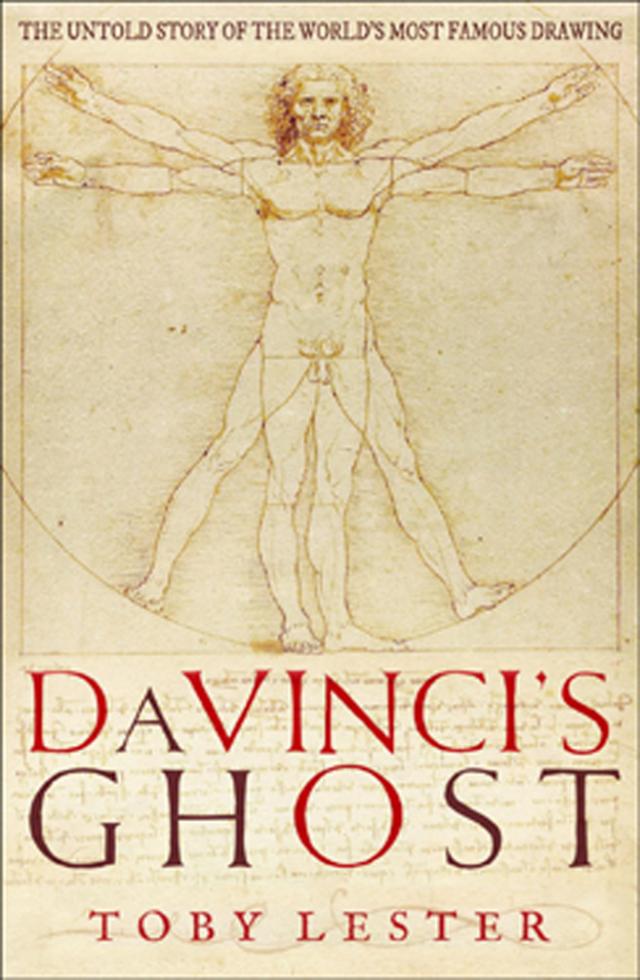
‘Every once in a while that rare book comes along that is not only wonderfully written and utterly compelling but also alters the way you perceive the world. Toby Lester’s Da Vinci’s Ghost is such a book. Like a detective, Lester uncovers the secrets of an iconic drawing and pieces together a magisterial history of art and ideas and beauty.’ David Grann, author of The Lost City of Z
‘In reconstructing the forgotten story of Vitruvian Man, Toby Lester, a canny decoder of images and a great storyteller, sheds new light on the enigmatic Leonardo Da Vinci.’ Chris Anderson, author of The Long Tail and Free
‘Like Da Vinci’s famous drawing, Toby Lester’s book is a small wonder—a work of brilliant compression that illuminates a whole world of life and thought. Lester proves himself to be the perfect guide to the Renaissance and beyond—affable, knowledgeable, funny. Leonardo’s Vitruvian Man turns out to be a road map that can take us to remarkable places—once you learn how to read it.’ Cullen Murphy, Vanity Fair
‘One of the great contributions of books like this is to keep the reader from taking a familiar object for granted. Lester’s detective story has a satisfying number of insights … covers a broad swath of history … [and] braids intellectual threads—philosophy, anatomy, architecture, and art—together in a way that reaffirms not only Leonardo’s genius but also re-establishes the significance of historical context in understanding great works of art.’ Publishers Weekly
ALSO BY TOBY LESTER
The Fourth Part of the World
DA VINCI’S GHOST
The Untold Story of the World’s Most Famous Drawing
TOBY LESTER
First published in Great Britain in 2011 by
PROFILE BOOKS LTD
3A Exmouth House
Pine Street
London EC1R 0JH
www.profilebooks.com
First published in the United States of America in 2011 by
Free Press, a division of Simon and Schuster, Inc.
Copyright © Toby Lester, 2011
1 3 5 7 9 10 8 6 4 2
Designed by Ellen R. Sasahara
Printed and bound in Great Britain by
Clays, Bungay, Suffolk
The moral right of the author has been asserted.
All rights reserved. Without limiting the rights under copyright reserved above, no part of this publication may be reproduced, stored or introduced into a retrieval system, or transmitted, in any form or by any means (electronic, mechanical, photocopying, recording or otherwise), without the prior written permission of both the copyright owner and the publisher of this book.
A CIP catalogue record for this book is available from the British Library.
ISBN 978 1 84668 454 8
eISBN 978 1 84765 806 7
The paper this book is printed on is certified by the © 1996 Forest Stewardship Council A.C. (FSC). It is ancient-forest friendly. The printer holds FSC chain of custody SGS-COC-2061
For Jim Lester (1927–2010), too marvelous for words
CONTENTS
Preface
Prologue: 1490
1: Body of Empire
2: Microcosm
3: Master Leonardo
4: Milan
5: The Artist-Engineer
6: Master Builders
7: Body and Soul
8: Portrait of the Artist
Epilogue: Afterlife
Further Reading
Notes
Works Cited
Acknowledgments
Permissions and Credits
Index
PREFACE
THIS IS THE story of the world’s most famous drawing: Leonardo da Vinci’s man in a circle and a square.
Art historians call it Vitruvian Man, because it’s based on a description of human proportions written some two thousand years ago by the Roman architect Vitruvius. But not everybody knows that name. When I mention it to people, they often react with a blank stare—until I start to describe the picture. Then, invariably, their eyes light up with the spark of recognition. “Wait,” one person said to me, “the guy doing naked jumping jacks?”
Call it whatever you like, but you know the picture. It’s everywhere, deployed variously to celebrate all sorts of ideas: the grandeur of art, the nature of well-being, the power of geometry and mathematics, the ideals of the Renaissance, the beauty of the human body, the creative potential of the human mind, the universality of the human spirit, and more. It figures prominently in the symbology of The Da Vinci Code and has been spoofed gloriously on The Simpsons. It shows up on coffee cups and T-shirts, on book covers and billboards, in movies and online, on corporate and scientific logos, on international spacecraft. It even appears on the Italian one-euro coin, guaranteeing that each day millions of people will hold it in their hands. In short, it’s a worldwide icon of undeniable reach and appeal—but almost nobody knows its story.
I first began to get interested in that story while at work on my previous book, The Fourth Part of the World (2009), which tells the story of the remarkable map that in 1507 gave America its name. In writing that book I delved deep into the weird and wonderful world of early maps, geographical ideas, and visions of the cosmos—and one day I stumbled across a medieval world map that immediately grabbed my attention. What struck me about it was what strikes everybody when they first see it: its uncanny resemblance to Vitruvian Man (Figure 1).
The more I studied medieval manuscripts, the more I came across similar images—in maps of the world, diagrams of the cosmos, guides to the constellations, astrological charts, medical illustrations, and more. Leonardo, I began to realize, hadn’t conjured up Vitruvian Man out of the blue. The figure had a long line of predecessors.
I discussed Vitruvian Man briefly in The Fourth Part of the World, in the context of medieval and Renaissance mapping. The picture occupied only a peripheral place in the story I was telling, and soon I had to leave it behind. But as I moved forward I found myself glancing back in my mental rearview mirror at the receding form of Vitruvian Man. What else might be embedded in that picture? What forgotten worlds might it contain? What sort of a window on Leonardo and his times might it provide? Why had nobody ever tried to tell the picture’s story? Soon enough I was hooked, and the result, some two years later, was this book.
Figure 1. The Lambeth Palace world map (c. 1300). Inscribed in a circle and a square, Christ embodies and embraces the world.
ON THE SURFACE, the story seems straightforward enough. Writing at the dawn of the Roman imperial age, Vitruvius proposed that a man can be made to fit inside a circle and a square, and some fifteen hundred years later Leonardo gave that idea memorable visual form. But there’s much more to the story than that. Vitruvius had described his figure in an architectural context, insisting that the proportions of sacred temples should conform to the proportions of the ideal human body—the design of which, he believed, conformed to the hidden geometry of the universe. Hence the importance of the circle and the square. Ancient philosophers, mathematicians, and mystics had long invested those two shapes with special symbolic powers. The circle represented the cosmic and the divine; the square represented the earthly and the secular. Anybody proposing that a man could be made to fit inside both shapes was therefore making an age-old metaphysical statement. The human body wasn’t just designed according to the principles that governed the world. It was the world, in miniature.
To an almost astonishing degree, this idea, known as the theory of the microcosm, was the engine that had powered European religious, scientific, and artistic thought for centuries, and in the late fifteenth century Leonardo hitched himself to it in no uncertain terms. If the design of the human body really did reflect that of the cosmos, he reasoned, then by studying it more carefully than had ever been done before—by using his unparalleled powers of observation to peer deep into his own nature—he might expand the scope of his art to include the broadest of metaphysical horizons. By examining himself in minute detail, he might see and understand the world as a whole.
Vitruvian Man sums up that dream in powerful visual form. At a superficial level, the picture is simply a study of individual proportions. But it’s also something far more subtle and complex. It’s a profound act of philosophical speculation. It’s an idealized self-portrait in which Leonardo, stripped down to his essence, takes his own measure, and in doing so embodies a timeless human hope: that we just might have the power of mind to figure out how we fit into the grand scheme of things.
THE STORY OF Vitruvian Man is actually two stories: one individual and one collective. The individual story, of course, is Leonardo’s own. Set in the years immediately leading up to 1490, it’s the story, as best I’ve been able to reconstruct it, of how Leonardo came to draw his famous picture—and it’s a surprisingly unfamiliar tale. Like Vitruvian Man, Leonardo himself has become such a popular icon, deployed for so many different purposes, that he’s rarely encountered as an actual person. Instead, he’s almost entirely a creature of myth: a prophetic, maguslike figure invested with almost superhuman traits who completely transcended his age. As one modern historian has put it, echoing the words of countless others, “Leonardo, the complete man of the Renaissance, paces forth, as far removed from medieval man as imagination can conceive.” But that’s not the figure you’ll encounter in this book. The Leonardo who drew Vitruvian Man turns out to be every bit as medieval and derivative as he is modern and visionary—and he’s all the more complex, fascinating, and mysterious for that.
The second story unfolds on a
By definition, the two stories start out at a considerable remove from each other. I’ve constructed them in very different ways, one as a personal story, told at the ground level, and the other as a story of ideas, surveyed from a considerable altitude. But as the book progresses, the two slowly wrap themselves around each other until, in the final chapter, they become one and the same. Both are strongly visual, which is why this book includes so many period drawings and diagrams. Flip through the pages quickly from front to back, and you should be able to see those images flickering to life, almost like movie stills being sped up, as they gradually evolve into Leonardo’s Vitruvian Man.
“THIS WAY, PLEASE.”
One damp, cold morning in March, a security guard at the Gallerie dell’Accademia, in Venice, asked me to follow her through the museum’s grand exhibit halls. For almost two hundred years the Accademia has owned Vitruvian Man, and I had come to see it in person.
Off we went. Without once looking back, the guard strode purposefully through room after room, weaving her way through packs of museum visitors gazing at some of the most celebrated paintings in the history of Italian art. I scurried to keep up. Eventually we reached the back of the museum, where we were met by another guard. He asked us to wait while he radioed ahead for clearance, then directed us into a cordoned-off stairwell and waved us upward.
Vitruvian Man only very rarely appears on display at the Accademia. Most of the time the picture is kept out of harm’s way, in a climate-controlled archive not accessible to the general public. To see it you have to request special permission from the director of the museum’s Office of Drawings and Prints, Dr. Annalisa Perissa Torrini, who, if she deems your request worthy, will guardedly schedule a private viewing.
When at last I was ushered into the archive, I found her waiting for me. We greeted each other and made pleasant small talk for a short while. Then, moving to a nearby display table, we got down to business. Dr. Perissa Torrini donned a pair of slightly tattered white cotton gloves and asked me to do the same. She walked over to a bank of flat file drawers, slid one open, and lifted out a manila conservation folder, which she carried back and gingerly placed on the table. Straightening up, she looked over at me.
“Okay,” she said, a smile creeping onto her face. “Are you ready?”
Man is a model of the world.
—Leonardo da Vinci (c. 1480)
DA VINCI’S GHOST
PROLOGUE
1490
ON JUNE 18, 1490, a small group of travelers set out from Milan for the university town of Pavia, some twenty-five miles to the south. A well-worn road connected the two cities, and the journey promised to be a pleasant one—a late-spring saunter across the verdant Lombard Plain. The trip lasted several hours. Riding past clover-strewn meadows, shady stands of poplars, and farmland crisscrossed with irrigation canals, the travelers had plenty of time to take in the scenery, soak up the country air, and make easy conversation.
When at last they reached Pavia, they brought their horses to a clattering halt in front of an inn called Il Saracino. The innkeeper, Giovanni Agostino Berneri, must have rushed out to greet his new guests. Two of them, after all, had been summoned to Pavia by none other than Ludovico Sforza, the selfproclaimed duke of Milan, whose dominion extended to Pavia and far beyond. The duke had visited Pavia not long before, and on June 8, after surveying the construction of the town’s new cathedral, which he had commissioned just two years earlier, he had relayed a request to his personal secretary in Milan. “The building supervisors of this city’s cathedral have asked, and made pressing requests,” he wrote, “that we agree to provide them with that Sienese engineer employed by the building supervisors of the cathedral in Milan. … You must talk to this engineer and arrange that he come here to see this building.”
The engineer in question was Francesco di Giorgio Martini, one of the most famous architects of his day, who at the time was in Milan, studying plans for the design of the tiburio, or domed crossing tower, soon to be built in the city’s unfinished cathedral. But in a postscript to his letter the duke asked that two experts of his own choosing also be sent. One was Giovanni Antonio Amadeo, a well-known local architect who was working on the tiburio with Francesco and had received other commissions from the duke. The other was a much less obvious choice: a thirty-eight-year-old Florentine painter and sculptor, based in Milan, who had no experience as a practicing architect. In his letter the duke called him “Master Leonardo of Florence,” but he’s known today by a different name: Leonardo da Vinci.
The duke’s secretary dutifully looked into the matter and responded two days later. Francesco, he reported, had more work to do but would be able to leave Milan in eight days. Amadeo couldn’t join him, because he was involved in an important project on Lake Como—but Leonardo, he said, had expressed great interest in accompanying Francesco to Pavia. “Master Leonardo the Florentine,” he wrote, “is always ready, whenever he is asked. If you send the Sienese engineer, he will come too.”
Not long afterward, Francesco of Siena and Leonardo of Florence set out for Pavia, accompanied by a small group of colleagues and attendants. Had anybody traveling with the group that day been asked which of the two men would still be remembered five hundred years later, the answer would have seemed obvious: the great Francesco. Even by the middle of the sixteenth century he was already being said to have contributed more to the development of Italian architecture than anybody since the legendary Filippo Brunelleschi. Francesco’s reputation stemmed from his accomplishments not only as a prolific master builder but also as an author and a graphic artist; his illustrated treatises were copied more often during the fifteenth and sixteenth centuries than those of any other artist. By the time he came to Milan in 1490, he was perhaps the most sought after architectural consultant in all of Italy. That year alone he traveled from Siena to Bologna, Bracciano, Milan, and Urbino to discuss building projects. And to Pavia, of course, in the company of Leonardo—whose legacy as an artist and engineer would soon eclipse his own.
ONE OF THE earliest surviving descriptions of Leonardo, based on the recollections of a painter who knew him personally in Milan, provides an idea of what he looked like when he and Francesco set out for Pavia. “He was very attractive,” the description reads, “well-proportioned, graceful, and good-looking. He wore a short, rose-pink tunic, knee-length at a time when most people wore long gowns. He had beautiful curling hair, carefully styled, which came down to the middle of his chest.” This already is a largely forgotten Leonardo—not the pensive, bearded elder of legend but a much younger man, still busy fashioning his own image.
If any of this provoked doubts in Francesco about his traveling companion, they can’t have lasted long. According to another artist who knew him, Leonardo was “by nature very courteous, cultivated, and generous”—a genial person to spend time with. “He was so pleasing in conversation,” one of his earliest biographers records, “that he won all hearts.” Leonardo may well have revealed another side of his personality to Francesco as the two men settled into their journey: his passion for jokes. In his private notebooks he recorded scores of them, many of which involve a kind of inside humor that might have worked to break the ice with a fellow artist. “It was asked of a painter why,” one of them went, “since he made such beautiful figures, which were but dead things, his children were so ugly. To which the painter replied that he made his pictures by day and his children by night.”






