

Rabbit rabbit rabbit, p.1
Rabbit Rabbit Rabbit, page 1


Copyright © 2024 Nadine Sander-Green
Published in Canada in 2024 and the usa in 2024 by House of Anansi Press Inc.
houseofanansi.com
All rights reserved. No part of this publication may be reproduced or transmitted in any form or by any means, electronic or mechanical, including photocopying, recording, or any information storage and retrieval system, without permission in writing from the publisher.
All of the events and characters in this book are fictitious and any resemblance to actual persons, living or dead, is purely coincidental.
House of Anansi Press is a Global Certified Accessible™ (gca by Benetech) publisher. The ebook version of this book meets stringent accessibility standards and is available to readers with print disabilities.
28 27 26 25 24 1 2 3 4 5
Library and Archives Canada Cataloguing in Publication
Title: Rabbit rabbit rabbit : a novel / Nadine Sander-Green.
Names: Sander-Green, Nadine, author.
Identifiers: Canadiana (print) 20230483275 | Canadiana (ebook) 2023048333X ISBN 9781487011291 (softcover) | ISBN 9781487011307 (EPUB)
Classification: LCC PS8637.A538765 R33 2024 | DDC C813/.6—dc23
Cover and book design: Greg Tabor
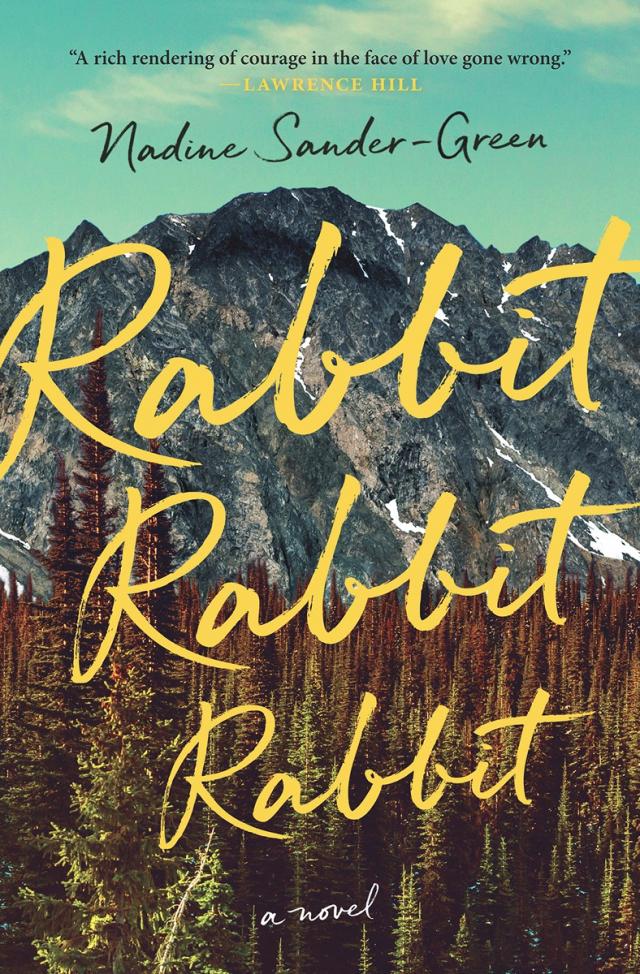
Cover image: Galyna Andrushko / Adobe Stock
Ebook developed by Nicole Lambe
House of Anansi Press is grateful for the privilege to work on and create from the Traditional Territory of many Nations, including the Anishinabeg, the Wendat, and the Haudenosaunee, as well as the Treaty Lands of the Mississaugas of the Credit.
We acknowledge for their financial support of our publishing program the Canada Council for the Arts, the Ontario Arts Council, and the Government of Canada.
To my mom and dad, who taught me to be brave.
1
perfect equilibrium, twelve hours of light and twelve hours of dark. Soon night would pull its blinds over the city for the winter. For now, if you didn’t look too closely, Whitehorse was like any small city down south. On the outskirts: a strip mall with Starbucks, Walmart and Canadian Tire. On the main street: some restaurants, cafés and bars; a few gift shops, businesses and hotels.
It was the end of September. Tourists who drove up the Alaska Highway in their RVs to see the vaudeville show and the old sternwheeler and buy eighteen-dollar Sam McGee Sours had fled to Florida for the winter. Locals, the ones who’d been lucky this year, had already skinned, butchered and packaged their moose. They were tucked safely back in their government offices. The streets were empty, like a movie set after hours.
The Golden Nugget newspaper was on Second Avenue, one of the main arteries that led out of town, a block away from the river. The office looked like a Western saloon: pea-green exterior walls, dirty white shutters on either side of every window. Next door, the neon sign for the Mad Hatter bar flickered.
Across the street, a giant mascot dressed like a maple leaf, top-heavy in his silver tights and running shoes, waved maniacally at every passing car, gyrating his hips and pointing to the logo on his chest, Northern Tax Solutions. When there was a break in the morning traffic, he sat slumped on the curb, kicking pebbles or tilting his head back to stare in quiet contemplation at the sky, only to jump up again and start dancing the Macarena for the next set of cars.
Millicent paced on the sidewalk outside the door to the newspaper, her heart a wasp trapped in a glass jar, beating hard and wild against her rib cage. She couldn’t believe she had arrived in Whitehorse not even ten hours earlier. In the cheap highway motel where she had spent the night, the people in the room next door blared cop movies until dawn. She tossed and turned in the cardboard sheets, until finally at six, unsure if she had slept at all, she hauled herself into the shower and used the little bottles of shampoo and conditioner to wash her greasy hair. For at least an hour, she agonized over which outfit to wear, posing in front of the mirror in the cramped bathroom, trying to ignore the bags under her eyes and the fact that whatever she tried on, she looked like a secretary from the 1950s.
A gust of wind from the river blew through her tights and billowed her jacket like a sail. The air had an edge, like a blade slicing into her lungs. Millicent swallowed the lump in her throat and unclenched her fists. A bell jingled overhead as she pushed open the door to the Golden Nugget, announcing her arrival.
Inside, the dark empty lobby smelled like office supplies and cigarette smoke. Most of the room was taken up by a long wooden counter that looked like it belonged in a nineteenth-century hotel. On top of the counter was a bell and a sign handwritten in jiffy marker that read Ring if You Must.
Millicent crept through the lobby, her Mary Janes making no noise on the floor. She paused at the stairwell. The smell of wet ink wafted up from the basement. From upstairs came the muffled sound of a radio, the only sign of life in the building. She took the stairs slowly, clutching the handrail.
The newsroom was a sprawling space that took up most of the second floor. There were lots of desks, but they had no chairs and were covered in stacks of yellowing newspapers. Two workstations were set apart towards a corner. One was scattered with notebooks and paper coffee cups. A Vince Carter poster was thumbtacked to the wall above it. The other workstation, which was clear except for a desktop computer and a red telephone, she assumed was hers.
On the far side of the newsroom was an office. The sign on the door said Editor. A wide interior window beside the door looked out over the newsroom. Millicent glanced through the window. Franc, her new boss, sat with his head bowed over the desk.
He was scribbling on a series of pink sticky notes. A boombox on the windowsill blared the cbc news report: Up next on your morning news, Premier Jakowsky is expected to announce plans for the Vista at a press conference this morning. A Whitehorse daycare has shut its doors after several dog-biting incidents. And Dirty Bird Hot Chicken officially opened to a lineup three blocks long.
Franc was older than he had sounded on the phone. Black hair covered the backs of his hands. He wore a faded jean jacket with a wool lining. Underneath this, she could just make out a T-shirt with what appeared to be a wolf howling at the moon, the kind she had seen for sale next to decorative shot glasses, postcards of the Arctic circle and canisters of bear spray in the string of identical gas stations along the Alaska Highway.
Millicent wished she had dressed more casually. Her stiff pencil skirt cut into the flesh of her stomach. The door was open just a crack. She knocked softly. There was no answer, so she opened the door wider, standing half in the office, half in the newsroom. Franc either didn’t hear her or didn’t care. Each time he finished a sticky note he slapped it on top of the desk, cleared his throat and started a fresh one.
Millicent stood still, one hand sweating on the doorknob. Where else was she supposed to go? The newsroom was empty. Morning light poured through the half-dozen tall, wide windows.
On the boombox, the weather cut in, a hushed voice reading through the temperatures for Dawson, Mayo, Carcross, Watson Lake and Old Crow. Franc looked up from his desk as though he had just noticed her. His face was blank. He motioned for her to come in.
Millicent forced a smile and sat down on the hard wooden chair across from the desk. She shifted, waiting for him to say something. The head of a black bear was mounted on the wall behind the desk, next to a framed degree: Carleton University ’85. Underneath these hung a series of certificates claiming Franc was the winner of Sourdough Sam’s Log Toss in 1995, 1996 and 1999. The bear’s chocolate fur and black glassy eyes gleamed under the office’s fluorescent lights. From the large outer window she could see beyond the scaffolding of Riverbend Estate, the high-end condo building under construction next door, towards the crest of a mountain that seemed to rise right out of the river and cut off a slice of the endless sky. The peaks were soft, as if the cold, dry northern wind had humbled them.
“So what brings you to the majestic north?”
Millicent’s face grew hot. She recognized his hoarse voice from the phone. It sounded like he hadn’t spoken in days.
“Well, this job,” she said.
She wondered if he knew who she was. Maybe he didn’t remember she was starting today. Maybe he’d forgotten entirely that he’d hired her. After all, the phone interview hadn’t taken any longer than setting up a hair appointment.
Franc tapped his fingernails against his desk. He looked out the window. “Most of you young kids come up here to add a notch to your belt, so you can say you did it. Lived in the Yukon. Saw the northern lights. Learned how to swing an axe. Drove a fucking dogsled team. I don’t know.” Franc shook his head. “Last about three months before running down home.”
“That doesn’t sound like me.”
Franc glanced at Millicent. There were olive-tinged shadows under his eyes. She wondered if he had spent his entire career sitting at this very desk.
“Hope not.”
Millicent straightened her posture.
“You’ll write at least two articles every morning, three if you have time. The more words the better; don’t listen to any of that bullshit they teach you in j-school about cutting down your words. That’s great if you’re at the New York Times. We have a paper to fill here. Every single day.” Two or three articles every morning. Millicent thought back to the phone interview with Franc that hot evening in August.
Millicent had graduated from college
It had been so easy to get hired. Too easy. Franc had asked her three questions.
“Do you have a reliable car?”
“Sure,” she said.
“Winter tires?”
“Um, yes.”
“Can you write fast?”
Millicent thought for a moment and then spoke in her most confident tone. “Yes.”
“I’d like to bring you up here,” he said.
“For an interview?” she asked.
Franc laughed. “For the job. When can you start?”
She hung up the phone, unable to find the right words to explain to her dad what had just happened. She didn’t need to. He rested the knife on the cutting board. Go, he said.
franc was staring past Millicent at his half-open office door. She hadn’t expected to be thrown in like this on her first day of work. He was still talking, something about covering Question Period when it was session, that most of the politics up here was bullshit talking-heads like the rest of the world, but the Nugget still had to cover it. Millicent realized she had stopped listening. She had no idea how much she had missed. Feeling guilty, she stared at the back of the door. Hanging on a hook were an umbrella and a plastic bag from Walmart that probably contained Franc’s lunch. A metal fork had punctured the bag.
“When it’s not in session you’ll help Bryce out with the regulars. He’s the sports reporter, Franc was saying, using air quotes, “but due to some capacity issues he does it all. Car crashes, high school graduations, parades, fires, suicides. You name it.”
“Suicides,” Millicent repeated.
“News is news.”
Franc had risen from his chair and was leaning against the window ledge. Millicent could smell him: wood smoke and sweaty wool, as if he had been working outside all morning and neglected to shower. He jiggled the window open halfway and a cool draft entered the office. He pulled a fresh pack of du Mauriers from his back pocket and fumbled with the wrapping. He held out the box to Millicent, who shook her head, shocked that he was smoking indoors.
“Can’t just cherry-pick what we cover,” Franc said. “Would you agree?”
“I don’t know.”
“Yes, you do.”
Behind his glasses, Franc’s eyes were glassy and green like stones at the bottom of a river. Her heart began firing in her chest again. This was a test.
“I learned it’s unethical, covering suicides,” Millicent said. “For the family’s privacy, but also because studies have shown that publicizing suicide can lead people suffering from depression to actually do it.”
She was surprised that she remembered these facts from journalism class in such detail. Millicent was never sure if it was fair to call what she was learning “journalism.” She attended an arts school that hired broke poets to teach students how to ask open-ended questions, and to bring pencils to press conferences, not pens, in case it rained.
“Is that right?” Franc said, trying to hide a smile.
“That’s what I learned.”
“I was just checking you went to j-school.”
“Of course I did.”
“Of course you did.”
They were both smiling now. The transformation of nervousness into relief made Millicent feel brave, delirious almost.
“Did you not read my resume?”
“Just threw the whole lot down the stairs and yours landed at the bottom, so I dialed you up.”
Now Franc turned his back to her. His shoulders were broad and curved inward. He inhaled and tapped the ashes out the window. The longer he stood there smoking the more Millicent questioned if she had imagined the playfulness. For a few moments she thought she actually might survive here. She wondered if this meet-and-greet was over, if this was her cue to leave.
“That’s me and Charlie. Out on the trapline,” Franc said just as Millicent was about to stand up.
She scanned the office until she found what he was talking about: a small framed photo on the wall, next to his university degree, that she had overlooked. She wanted to ask who Charlie was, but the way Franc had said his name made it seem like he was someone she should already know. A famous person, perhaps.
“Where’s the trapline?”
Franc didn’t answer. He finished his cigarette, put it out in a can of Folgers that sat on the window ledge and sat back down at his desk. Millicent looked at the photo: a younger, slimmer Franc with one arm tossed over the shoulder of a shorter man in a baseball cap. This man had darker skin and softer eyes. Clutched in Franc’s free hand by its two hind legs: a frozen dead animal. White fur. A rabbit. The other man was reaching out his arm to take the photo. They were both beaming.
“Looks beautiful out there,” Millicent said.
Franc kept his gaze on his half-open office door. He swallowed loudly. “When you’re finished your story, yell out the headline. If it’s cat stuck in tree, yell Cat stuck in tree! Loud enough so I can hear it, please. Then I’ll comb through and send it off to production. Paper goes to print at noon. No exceptions.”
Through the office window, she saw a lanky man wearing a backpack and a bike helmet come into the newsroom. He seemed to be moving in slow motion. Millicent watched as he slowly shrugged off the backpack. He took off his glasses and cleaned them on his hoodie. When he took his helmet off, she saw that his hair was so blond it was almost white. He settled into the chair under the Vince Carter poster.
“Bryce,” Franc said.
Millicent opened her mouth to say something, but nothing came out.
“Jakowsky’s making an announcement in half an hour. This could be the big one. You’ll cover it.”
Franc peeled one of the sticky notes from his desk and handed it to Millicent. She could barely read his hurried cursive. Jakowsky. Vista. Rec Centre. 10.
“The big one?”
“Could be.”
“What do you mean?”
“You know who Jakowsky is, right? The premier? Our premier? Please tell me you knew that.”
2
bryce’s knees pressed into the dashboard of Millicent’s father’s 1994 Mazda Protegé. Other than to mutter “Left here,” or “Take a right,” Bryce was quiet on the drive up to the press conference. The car smelled like musty, damp towels. Her boxes and bags, all her life’s belongings, were still crammed into the back seat and the trunk. The car radio didn’t work, neither did the back doors nor any of the windows. The windshield had so many cracks Millicent had to slump in her seat to get a clear view.
What a strange feeling to have another human in the car after the solo drive north. Bryce’s presence seemed to take up the entire car. He smelled a bit like weed and a bit like something else, something comforting. Nutmeg, maybe. His hands were large and he rested them open on his thighs as if he didn’t know what to do with them. He wore a friendship bracelet, the braided thread faded and soft, the kind an eight-year-old girl might make for her best friend.
“From my niece, back in Ontario,” he said when he saw her looking at it.
“Pretty.” Millicent forced herself to concentrate on the road that went up from town, the blur of big-box stores, the lights turning from red to green. Bryce stared out the passenger window.
“I’m assuming you don’t know much about the Vista?” he asked.
Millicent squawked out a laugh. “Nothing.”
Bryce smiled, holding his gaze out the window. “Here’s the short and sweet. It’s all you really need to know. The Vista is this huge chunk of wilderness, bigger than Scotland—that’s what they say. Everyone up here has been fighting over it for a decade. The price of gold is ridiculous right now, something like sixteen hundred dollars per ounce, they’re calling it the second gold rush. So of course Jakowsky wants to let this Chinese company, GoldPower, rip the land up and build a mine. The Gwich’in, it’s on their traditional territory. They want to protect it. Always have, no matter how many jobs Jakowsky is promising. And now Charlie is running for premier and his whole campaign is about protecting the caribou herd, so obviously our old friend Jakowsky is feeling the heat.”






