

A land remembered, p.1
A Land Remembered, page 1


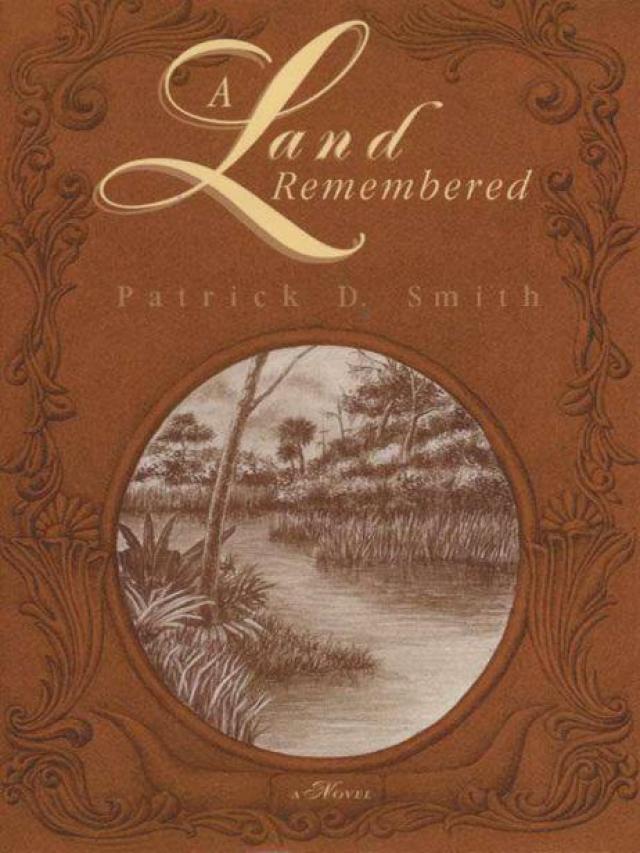
Table of Contents
ONE
TWO
THREE
FOUR
FIVE
SIX
SEVEN
EIGHT
NINE
TEN
ELEVEN
TWELVE
THIRTEEN
FOURTEEN
FIFTEEN
SIXTEEN
SEVENTEEN
EIGHTEEN
NINETEEN
TWENTY
TWENTY-ONE
TWENTY-TWO
TWENTY-THREE
TWENTY-FOUR
TWENTY-FIVE
TWENTY-SIX
TWENTY-SEVEN
TWENTY-EIGHT
TWENTY-NINE
THIRTY
THIRTY-ONE
THIRTY-TWO
THIRTY-THREE
THIRTY-FOUR
THIRTY-FIVE
THIRTY-SIX
THIRTY-SEVEN
THIRTY-EIGHT
THIRTY-NINE
FORTY
FORTY-ONE
FORTY-TWO
FORTY-THREE
FORTY-FOUR
FORTY-FIVE
A Land Remembered
A Land Remembered
Patrick D. Smith
Pineapple Press, Inc.
Sarasota, Florida
Copyright © 1984, 2012 by Patrick D. Smith
All rights reserved. No part of this book may be reproduced in any form or by any means, electronic or mechanical, including photocopying, recording, or by any information storage and retrieval system, without permission in writing from the publisher.
Inquiries should be addressed to:
Pineapple Press, Inc.
P.O. Box 3889
Sarasota, Florida 34230
www.pineapplepress.com
Library of Congress Cataloging-in-Publication Data
Smith, Patrick D., 1927–
A land remembered.
1. Title
PS3569.M53785L3 1984 813¹.54 84-12098
ISBN 978-0-910923-12-5 (hb: alk. paper)
ISBN 978-1-56164-116-1 (pb: alk. paper)
ISBN 978-1-56164-539-7 (e-book)
Hb: 45 44 43 42 41 40 39 38
Pb: 40 39 38 37 36 35 34 33
Printed in the United States of America
To the grandchildren—
Dan, Kimberly, Joshua and Matthew—
with love from “Grampy”
A Land Remembered
ONE
MIAMI, FLORIDA
1968
The silver Rolls-Royce glided off Key Biscayne as smoothly as a dolphin cutting the green water of the bay. Solomon MacIvey sat on the back seat, staring intensely at each house they passed, at the spotlessly manicured lawns, as if seeing these things for the first and last time. As they neared the causeway he muttered, “For what this one island is worth today my pappa could have bought the whole damned state back in eighteen eighty-three when I was born. Folks has gone as crazy as betsybugs.”
“That’s right, Mister MacIvey,” the driver agreed. “They all gone plumb crazy.”
When they came to a park bordered by stately royal palms the old man squinted his tired eyes at the entrance sign: “Solomon MacIvey Park.” Then he leaned forward, shook the driver’s shoulder and said, “You see that, Arthur? Bought that fifteen acres back in oh-nine for forty-seven dollars and fifty cents. Can you imagine it? And some folks thought I’d been skinned for paying that much. Bet not one damned soul who uses the park can say who Solomon MacIvey is or could care less. Probably cuss me as some empire-building bastard who stole everybody blind back in the old days and then gave this park to salve his conscience.”
The black driver nodded in agreement as he turned from the Rickenbacker Causeway and headed up Brickell Avenue. “You sure you want to go through with this, Mister MacIvey?” he asked, knowing what the answer would be but feeling he should ask again for the last time. “I could turn around and go back right now if you’ll change your mind.”
“I’ll not change my mind,” MacIvey grunted, “and there’ll be no turning back. I don’t want to see that big house again. Not ever! Not a single MacIvey died in a fancy place like that, and I’m damned if I’ll be the first. We’ll go to Punta Rassa as planned, but first I want you to drive up Miami Beach. I want to see it one more time.”
“Yes, sir, Mister MacIvey. I’ll turn across the MacArthur Causeway.”
As they crossed the causeway they could see cruise ships making their way into the port, their masts decorated gaily with multi-colored banners. Then the Rolls turned left onto Collins Avenue and moved slowly up South Miami Beach.
The streets here were lined with shabby, rundown apartments and hotels, porches filled with old people sitting in cane-bottom chairs, staring at nothing, some asleep and others perhaps even dead and as yet unnoticed, men and women who had retired from the harsh climate of the North and ended up trapped in the rococo world of South Miami Beach.
“It ain’t nothing but a walking cemetery,” MacIvey said, staring through heat waves that already drifted up from sultry sidewalks. “Should be turned back to the gulls and terns.”
As they continued up Collins Avenue it suddenly changed, as if a boundary line had been drawn across the island, the beach now lined with majestic hotels, one after the other, interspersed with towering condominiums, a concrete and glass canyon blocking the view of the ocean except for those willing to pay to see it from a balcony.
And then they came to the La Florida Hotel, sitting like a stuffed frog, rising boastfully above all of them, thirty stories, with the letters MCI blazened across its top. The old man said, “I hope someday the son of a bitch gets blown down. I should ’a never built it in the first place.”
From this point north the avenue was lined with motels and cocktail lounges and fast food emporiums and souvenir stores with their display windows stuffed with junk, some of it authentic Florida souvenirs made in Hong Kong.
MacIvey then said, “That’s enough, Arthur. I’d rather try to remember it like it was when I first saw it. Get us off of here at the very next exit.”
The driver turned left onto the Julia Tuttle Causeway leading to the mainland. The old man said, “You know who Julia Tuttle was, Arthur?”
“No, sir, I sure don’t.”
“Hell, I do! My mamma visited with her first time we came here in eighteen ninety-five, a few months after the big freeze. She lived in a part of old Fort Dallas. I think Mamma and her had tea together, or maybe it was fruit juice. When the freeze killed everything in Florida except for here, Julia Tuttle sent old man Flagler some orange blossoms up to Palm Beach, just to show him they were still blooming at Fort Dallas. And that’s how come he ran his railroad on down to Miami, ’cause the freeze didn’t kill the orange trees. Mamma liked her, but she never got to see her again. And I’ll bet ole Julia Tuttle would throw a tissy fit if she could see what this causeway leads to now. She’d probably want her name off of it.”
They turned left again at the mainland, cruising down Biscayne Boulevard, its northern section jammed with more motels and junk food shops, service stations, massage parlors, porno movies, bars, adult book stores, the sidewalks empty in the early morning sun but teeming at night with prostitutes and junkies and winos and professional muggers. Then they came into the downtown business section of Miami, passing the MacIvey State Bank Building with the letters MCI across the front entrance, then Bayfront Park with more winos and junkies and panhandlers and muggers.
The driver slowed and said, “What you want me to do now, Mister MacIvey, head out Highway Forty-one?”
“Not quite yet,” he responded. “Before we leave I want to see one more thing. I want you to drive through the area where they had the riot.”
“What?” the driver questioned, not sure he had heard right. “How come you want to do that? I’ve heard it’s not all over yet.”
“Dammit, you heard me, Arthur!” the old man snapped. “I want to see! Drive through there!”
“Yes, sir, Mister MacIvey,” he responded, shaking his head in disagreement but following orders.
He turned left at the next intersection and followed another boulevard, and soon they came to an area of gutted buildings, boarded-up storefronts and burned automobiles not yet removed from the streets. People standing idly along sidewalks stared with hostility as the Rolls ambled by.
“They did a pretty good job of it,” MacIvey commented as they moved out of the area. “But this isn’t the end of it. You mark my words, Arthur, there’ll be more, and the next one will be even worse. You bring this many different kinds of people together it’s like throwing wolves and panthers into a pen full of cows. The fur never stops flying.”
As they moved slowly through the congested traffic of the lower Tamiami Trail, the old man shook the driver’s shoulder again and said, “You know, Arthur, I don’t know why some folks was so shocked by the riot. Hell, this whole state was born of violence. You can’t go anywhere without stepping on the skull of some man or animal that was killed. The whole damned place is littered with bones.”
The driver had heard it all before, but he listened attentively as the old man continued, “What I haven’t seen myself I’ve read about. During these past fourteen years I’ve holed up in that house alone, I’ve read enough books to fill up Biscayne Bay. I know about those bloodthirsty Spanish conquistadors who came here with their crosses and killed everything in sight in the name of Christianity. Narvaez cut off the nose of chief Oc
“Yes, sir, Mister MacIvey. I know what you say is the truth.”
By now they had left the city and entered the Everglades with its endless stretches of open sawgrass dotted with distant hammocks of hardwood and palm. The road and both shoulders were littered with the decaying bodies of small animals struck by automobiles. Buzzards flapped out of the way as the car approached, and then returned to the carnage as soon as it passed.
Soon they came to the Miccosukee Indian Reservation bordering the highway, an area lined with airboat rides and tourist villages and craft stores, and after this they entered the Big Cypress Swamp. The road here was stained even worse with the blood and guts of more small animals crushed flat into the steaming asphalt.
The old man studied the passing landscape carefully. “Slow down, Arthur, so I can get my bearings,” he cautioned. “It’s been a while since I’ve been here.” After another three miles he said, “Turn right at the next dirt trail.”
The tires on the Rolls made crunching sounds as it glided slowly along a sandy road heavily lined with palmetto and pond cypress. A mother raccoon with her brood of babies scurried out of the way as they made a sharp turn and came into the edge of a clearing. MacIvey said, “Stop here and wait. It could be we’ll have another passenger.”
Several chickee huts were spaced at random around the clearing, and beneath one of them an old woman stirred a cooking pot with a wooden spoon. MacIvey approached her and said, “I’m looking for Toby Cypress.”
Without speaking she pointed toward a chickee at the far side of the clearing.
MacIvey hesitated for a moment, looking around the Seminole village, remembering the first time he had come here over seventy years ago, seeing that nothing had changed except faces. Then he walked to the chickee and found an old man sitting beside it, his hair solid white, his sun-baked skin as wrinkled as cypress bark. He seemed to be asleep as MacIvey said, “Toby Cypress?”
The old Indian squinted and said, “Yes. I am Toby Cypress. What is it you wish of me?”
“Don’t you know who I am?”
Toby Cypress pushed himself up and looked closer, and then he smiled. “Sol MacIvey! It has been many decades now, and age has ravaged both of us, but I would still know you. It is only a MacIvey who is so tall and lanky. Sit here with me and tell me why you have come back to the village after all this time.”
MacIvey settled himself to the ground in front of Toby Cypress and said, “You haven’t changed so much, Toby. Do you still ride a marshtackie like the wind?”
“No, Sol. I have not been on a horse for so long now I don’t remember. All I do is sit in the chickee like an old woman. I am growing tired of it.”
“We sure used to ride, didn’t we?” MacIvey said, remembering fondly. “And we had some good times together too. I’ve thought of them often. And I’ve kept track of you through the years although I haven’t been back here. I know you served for a long time as tribal leader and did many good things for your people.”
“Yes, this is so. We now have two reservations, but I’ve never lived there. I would rather stay here in the swamp where I belong. But many of my people live there, and we have cattle once again. But tell me, why have you come back now like a ghost from the past?”
“I’m on my way to Punta Rassa, to live my last days at the cabin Pappa built there. I’ve left my house in Miami and will never return to it. I would rather see things as they once were.”
“There is no more Punta Rassa as you knew it,” Toby Cypress said, his eyes reflecting sadness. “It is all gone, Sol, just as Lake Okeechobee as we once knew it is gone, and the custard-apple forest is gone, and the bald cypress trees are gone. You are trying to capture the fog, and no one can do that.”
“The cabin is still there, as good as ever, and the land too. I came to ask you to go with me. We can hunt and fish, and plant a garden, and be close like we once were.”
Toby Cypress picked up a stick and scratched in the dirt, and then he said, “There is a Seminole legend that says when an old man knows he is going to die, he goes off alone into the woods, searching for the place of his birth. That is what you are doing now, Sol. I will make the same journey very soon. But we must each do it in our own way. I cannot go with you to Punta Rassa.”
“I suppose not, Toby, but I just thought I’d ask. But I do want to part with you this last time as friends and as a brother, like it used to be. I’m sorry we broke away in anger those many years ago.”
“I am sorry too, and I am no longer angry at you for destroying the land as you did. But Sol, it could have never been different with us. We are brothers only because we had the same father. My mother was Seminole, and yours white, and we were born to live in different worlds. There was no other way. We have each lived our lives as we had to, and now we depart in different ways. But know this, Sol. I have always loved our father, Zech MacIvey, just as my mother loved him. And I have loved you too. I have no hatred in my heart. Believe this now, and we will go in peace.”
“That’s what I wanted to hear,” MacIvey said, his face relieved. “I have no children, Toby, and I am the last of the MacIveys. It ends with me, and that is my biggest regret from the way I messed up my life. But the MacIvey blood runs on in the veins of your sons, and I want you to know I’m proud of this. Pappa would be proud too. And there’s another thing I want you to know. All the land I still own that hasn’t been turned into concrete, and there is a great deal of it, including the land south of Okeechobee and along the Kissimmee River, I am turning into a preserve where the animals can live again as they once did.”
“That is good,” Toby Cypress replied, pleased, “but do it soon before there are no more birds in the sky and no more creatures on the land.”
“It’s already done. And all the money I leave behind will be spent to buy more land for preserves. It’s the least I can do now to make up for the bad things I’ve done in the past. Things I’m not proud of, Toby. And there’s a great deal of money to do this, more than you can imagine.” He then got up and said, “It’s time for me to go now, Toby. We won’t see each other again, so I’ll say farewell—and happy hunting.”
Toby Cypress pushed himself up slowly, then he grasped MacIvey’s hand. “Goodbye, Sol. Brother. We are both part of a time that is no more, and it is good that it ends soon for both of us. I hope you capture the fog and find a small part of it again in your last days.”
The two old men stood facing each other, Solomon MacIvey gripping the wrinkled brown hands tightly; then he turned and walked away. He did not look back as the Rolls retraced its way down the sandy trail.
* * *
Just before noon they came to the southern outskirts of Naples and into a logjam of traffic, cars and trucks moving slowly bumper to bumper, impatient drivers blaring horns and shaking fists at each other in anger. Both sides of the highway were lined solidly with fast food joints and service stations and shopping centers. When they stopped for a traffic light the driver said, “You want to stop now and get something to eat, Mister MacIvey? And it’s time for your pill.”






